The stranger who doesn't know anything about your industry
For a while I thought not knowing chimneys was a problem. It wasn't. It put me right where my customers already were.
My customers don't know about chimneys. They don't want to know about chimneys. They heard somewhere that they should get one swept or inspected, and now they're looking for someone to tell them what to book. All the extra stuff we sell, the add-ons, the specialty services, the things a technician might catch once they're actually on the roof, none of that is on a customer's radar walking in. It only becomes relevant once we're already in front of them.
That's when it clicked for me: anything I have to explain in order to sell it is the wrong thing to put on my website. The only things that belong on a bookable page are the things a person who knows absolutely nothing about your business or your industry already knows to ask for.
The inspection that kept costing us time
We do chimney inspections. Right now we offer two online: a Level I, which is a general well-being check, and a Level II, which we call the real estate or insurance inspection because that's when people usually need it. For a while, we also offered a third kind, a very specific inspection for a very specific type of chimney.
The problem was that almost nobody actually knew if they had that type of chimney. They'd read the description, think maybe it applied to them, and book it. Then we'd end up in a long back-and-forth, on the phone or over email, walking them through what they actually had. Most of the time, it turned out they didn't need that inspection at all. They needed a Level I or a Level II.
Once I saw that pattern, the fix was obvious. That specialty inspection didn't need its own spot online. It could just live as something our technicians bring up in person, when they're looking at the actual chimney and can tell in five seconds whether it applies. We stopped trying to get customers to self-diagnose something they had no way of knowing.
"The only things that belong on your website are the things a total stranger already knows to ask for."
— Emily Martinez
Why business owners overload their service list
When you're new, you want people to know everything you can do. You want to look capable, available, worth calling. So you list every service, every variation, every add-on you offer. It feels like you're being helpful.
But customers aren't shopping for your product list. They're shopping for a result. Nobody wants to become an expert in chimney inspection types just to book an appointment with you. When you hand them a long list of options to sort through, you're not showing off how much you can do, you're making them do the work of figuring out what they actually need. That's the opposite of helping them. Your job is to make things simpler for the customer, from the moment they book to the moment the job is done, not harder.
What actually belongs on your booking page
I recommend keeping your online bookable services to three to five, no more. If you haven't figured out what your first business system should be, this is the place to start. The ones you pick should meet three conditions:
- It's a service you're actually known for, the kind of thing people search for when they're trying to find someone like you.
- It has a standard price you can list without a conversation.
- You can deliver it reliably in a set amount of time.
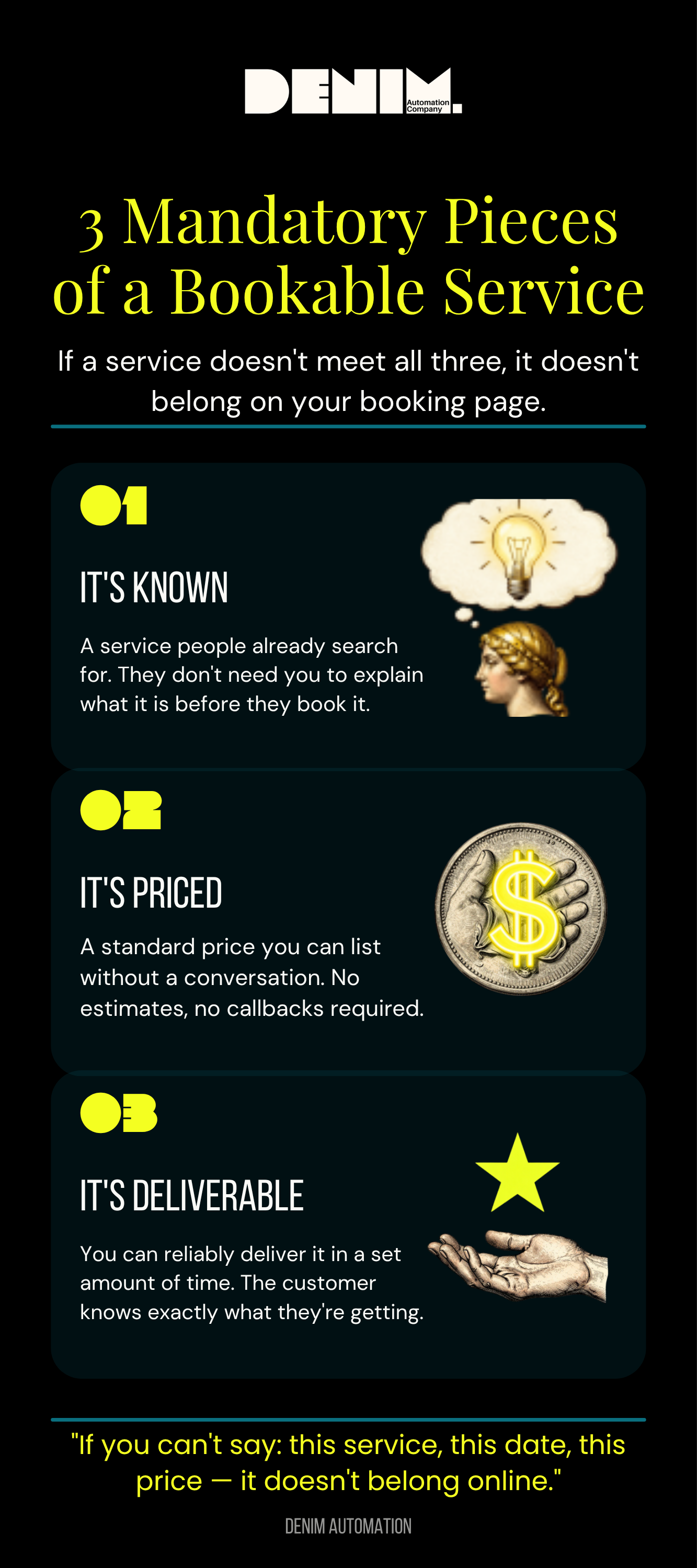
If you can't say to a customer, "I will deliver this to you on this date at this time, it will take this long, and it will cost this much," it doesn't belong online. A customer booking something on their own has to know exactly what they're getting before they hit confirm. If they don't, you're not making it easier for them, you're setting up a phone call you didn't need to have.
If you can't say to a customer "I will deliver X on this date, it'll take this long, and cost this much," it doesn't belong on your booking page. That's the whole test.
What changed when we cut it down
Once we pulled that confusing third inspection off the website and left just the two clean, well-defined ones, we started taking fewer calls. Not because we lost interest, but because people had fewer questions about what to book in the first place.
That was really just the beginning, though. Once we had our core bookable services locked down, we could standardize the way we deliver them, the messaging, the process, all of it, and then build everything else, every add-on and specialty service, as something our technicians offer in person instead of something a stranger has to guess at online. That's become the pattern for how we systemize anything in this business: strip it down to what's clean and provable, get that running well, then build out from there.
The takeaway
Your service list is not your booking page. A service list shows everything you're capable of. A bookable service is something a total stranger can book without needing you to explain it first. If you want people to actually book online instead of calling with questions, pick the handful of services that are known, priced, and deliverable on a schedule, and let everything else stay a conversation between you and the customer, not a guessing game on your website.