People ask me this a lot, usually with a little bit of doubt in their voice. Is the 4-hour work week thing actually real? I get it. It sounds like a gimmick. And I always clarify, this 4-hour work week is the amount of time I do the ADMIN side of the business. If you're the worker bee in your business, keep buzzing, little bee. Let me just answer it straight: I run The Village Chimney Sweep in about four hours a week right now. Not every week is exactly four hours, but it's close, and I can tell you exactly why, because I built it that way on purpose after living the opposite for years.
Yes, I read Tim Ferris's book and it got my wheels turning, however, in this case I didn't set out to build a 4-hour work week. I didn't even care about my hours in the beginning. What I actually cared about was that I was a mess, and being a mess was costing me real money.
The Story That Actually Started All of This
When I bought this business from my aunt and uncle, they had a system that worked fine for them. It was totally analog: carbon-copy invoices, paper changing hands. It worked because they saw each other every single day and could hand things off in person. However, my cousin/business partner and I didn't have that. We didn't live near each other, and I was suddenly working from home for the first time, trying to figure out how to organize a business while also organizing my space. Also, there was kid stuff absolutely all over my desk.
Needless to say the analog system was not for me. I had invoices sitting in the van instead of getting scanned in. I'd go three weeks without processing a stack of them. Then the chaos caught up with me in a way that actually hurt. We did a job for someone who turned out to be selling their house. The sale closed, they moved, started ghosting us, and they never paid us. We tried to track them down through their real estate agent, who told us flat out there was no forwarding address. That was it. We ate the cost of materials and the labor on a job that, for us at the time, was a big one.
That wasn't a time management problem. That was an "I am not a responsible steward of this business" problem, and I knew it. I needed to invoice quickly, follow up reliably, and get paid without waiting three weeks to even find out something was owed. The hours I saved later were a side effect of fixing that. They were never the goal.
The Shift That Changed Everything
I decided I needed real deadlines, meaning I had to get an invoice out before our technician even left the driveway if I wanted a shot at getting paid on the spot. I realized if I wanted to make sure the invoice was delivered immediately, I couldn't be the one typing it up in real time. If a human has to sit at a computer to make something happen, that thing is going to be slow and it's going to get missed.
"Speed equals money, and speed means the system does it, not me."
— Emily Martinez
All I had to do was find a system that delivered invoices. Simple! Once that system was in place, I started fixing other things that were falling through the cracks. Then my job stopped being "do the admin work" and became "glance at what's unusual." Our tech flags something in the field if it needs a second look, I check it, and that's it. What used to take me an hour of scanning and writing up after every single job now takes me nothing, because the invoice already went out while we were still standing in the customer's driveway.
That same shift is why, when it is time to bring on help, I won't need to hire someone full time. I can be very efficient with the sort of staffing I bring on. These are conductors in my business, not doers. It's the same shift I talk about in how to stop being the bottleneck in your own business — the second you're not the only one who can make the next thing happen, everything downstream of you gets faster too.
What Keeps Other Owners Stuck
When I talk to other home service owners who haven't built this out yet, the block usually isn't the technology. It's three things. First, they assume it's going to be way more complicated and time consuming than it actually is. Second, they haven't fully grasped how much better these systems will make their lives. Third, and this one surprised me when I noticed the pattern, a lot of owners don't want their schedule visible online because they think an open calendar makes them look slow, like it's a status symbol to always look booked solid.
I've found the exact opposite to be true. I tell customers all the time, "you called at the right time, we're not slammed this week," and they're happy about it, not suspicious of it. The more transparent I am about scheduling, pricing, and timing, the faster we can move and the more valuable we are to the people calling us. Hiding that stuff doesn't protect your business. It just slows everyone down, including you.
Where I'd Tell You to Start
There are a lot of directions you could go here, but I don't think you should start with the "right" one. Everyone has a different "right". Start with whatever's waking you up at night. For me that was getting paid. If you can set up automatic invoicing with automatic follow-up for people who haven't paid yet, that alone solves a huge chunk of the stress, because the money starts showing up without you having to chase it.
The second thing that was keeping me up was not having any kind of confirmation system when someone booked. I couldn't get back to people fast enough to tell them yes, we're coming, and I didn't have anything reminding them the day before. Building that out saved me more time than almost anything else, because it's the same message every time. Nobody needs a personalized essay reminding them their chimney sweep is showing up tomorrow. They need one reliable line, sent automatically.
So my advice to you is, build the exact system that will make your life easier right now.
Start with whatever's actually keeping you up at night — for me that was getting paid. Fix the system that solves that first, and the hours have a way of taking care of themselves.
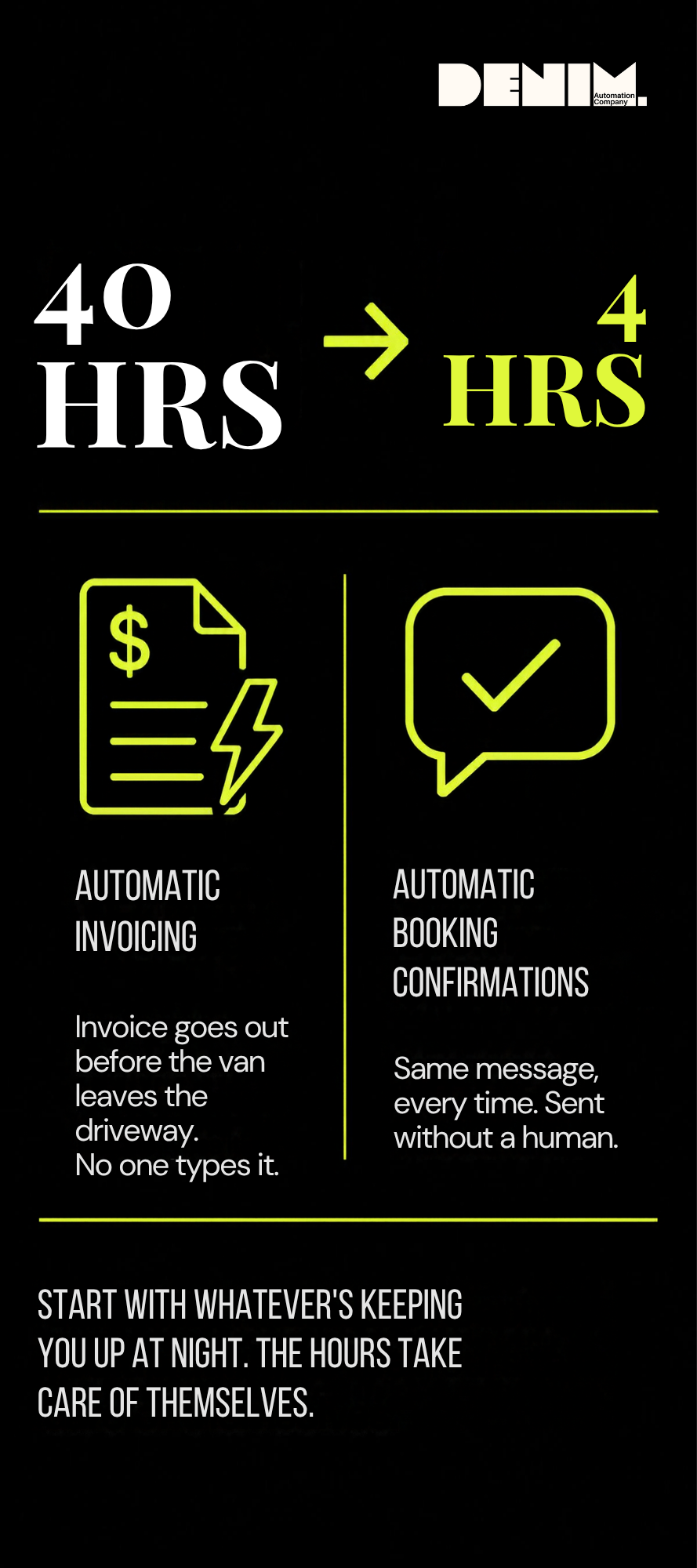
Automatic invoicing and automatic booking confirmations are two of the five systems I walk through, start to finish, in How I Automated My Local Biz with 5 Simple Systems. I put together 5 courses for a total of $25. Each course teaches a different system.
What It Actually Looked Like, Before and After
In the early days I was putting in a true forty hours a week, and it was a strange forty hours. I'd get up early to write emails, then sit on them so I didn't send anything at 5am and look unhinged, work through a gap in the middle of the day when my kids were awake, and pick it back up in the evening once my husband was home to help with the chaos. It was a nightmare, and almost all of it was repetitive admin work that had no business requiring a human every single time.
I built the systems piece by piece, mostly through trial and error, because nobody taught me how to do any of this. Solve three hours here, solve three more there. Now, most of my hours go toward building out Denim Automation, which I'm doing from scratch. The chimney sweep side takes about an hour a day, and I don't work Mondays at all because that's my technician's day off. A lot of what's left is genuinely just looking up parts for a specific job. I barely email customers anymore because they book online. I barely call people back because our website already answers most of what they'd be calling to ask.
So yes, four hours a week is real. It's just not where I started, and it's not why I started. I started because I was losing money to my own disorganization, and the time savings showed up because I fixed that first.