Every home service business has competitors. Every customer with a phone can call three of them in an afternoon. That's not the problem. The problem is what happens in your head — and in your mouth — the moment you realize you might lose the job over price.
The conversation that actually wins
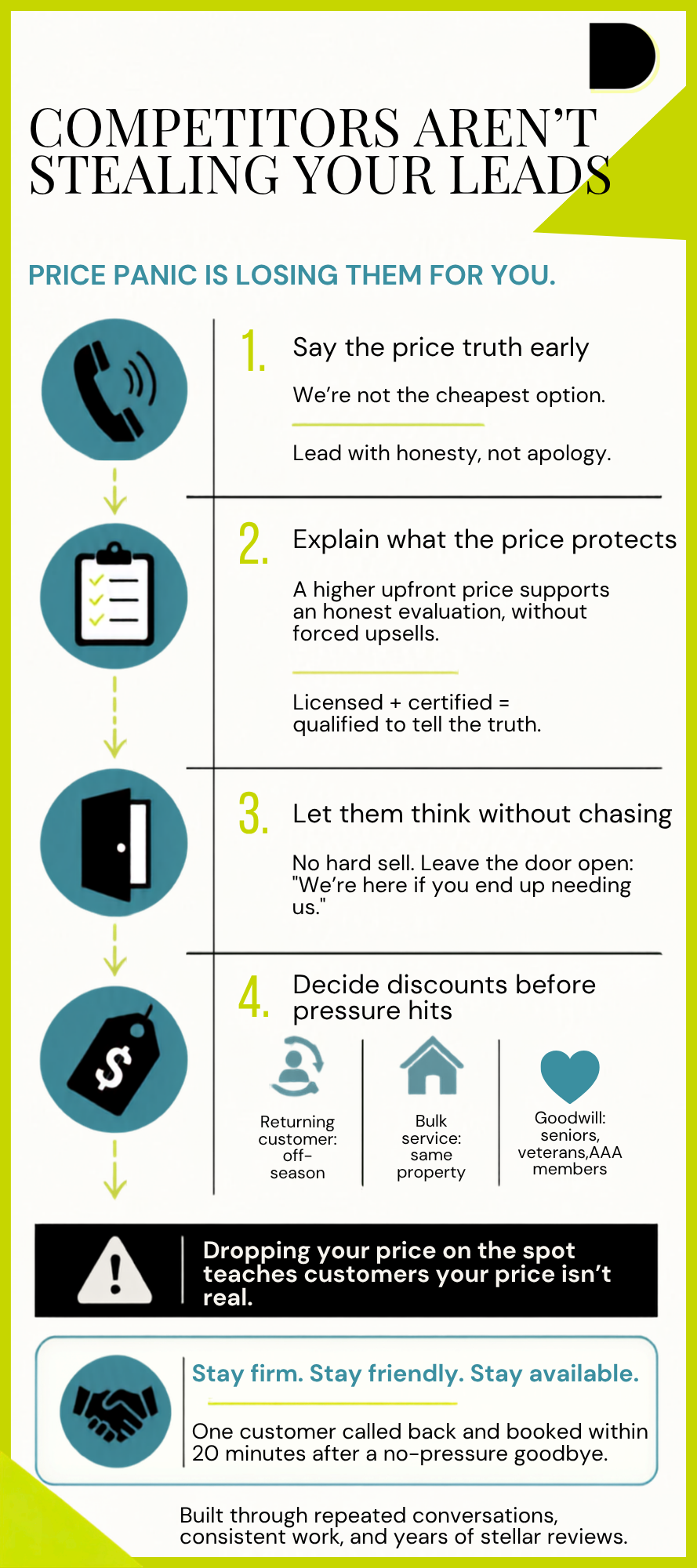
When a potential customer is only interested in price, we lose. Every time. So at The Village Chimney Sweep, we don't compete on price at all. We say it early, right in the first conversation: we are not the cheapest option. That's not a weakness we're apologizing for — it's the opening line of our pitch.
We explain why. We charge more on the front end so we can be more honest with our evaluation of their system. We don't have to upsell anything to pay our bills, because the visit itself already covers what it needs to. We're licensed and certified, which means the person showing up at their house is qualified to tell them the truth about their chimney, not just qualified to sell them a service. Once people understand that, we get the job.
It took me a while to be able to say all of that clearly. That message matured over time. It's not something I wrote once and had memorized on day one — it's something I built by having the conversation over and over until I knew exactly which parts mattered to people.
The send-off that brings people back
The other piece is what I do when someone isn't ready to commit. If a customer has heard my value pitch — on the phone, over text, by email, whatever — and they say they want to think about it, I never chase. I always leave it open and easy: "No problem! We're here if you end up needing us." Friendly, no pressure, door open.
That send-off gets us a lot of calls back. Just yesterday I talked to a customer who needed a chimney sweep. I gave them our value pitch, and they mentioned they were calling around to other companies too. We said our friendly goodbyes — no hard sell, no scrambling to sweeten the deal. They called back within twenty minutes and booked.
That's not a fluke. It's what happens when the value pitch actually lands and you don't undercut it by getting anxious in the moment.
"Competitors aren't stealing your leads. Price panic is losing them for you."
— Emily Martinez
Where I see business owners lose the job for real
I think most home service owners get too emotionally attached to their leads. I get it — sometimes you really need to close a sale. But the moment you show any desperation, customers can feel it. And every time I've been desperate enough to drop my price on the spot, I've ended up with a customer who turned into more of a headache. That's been true every single time.
The reflex is understandable. A lead says they're shopping around, and your gut says "offer something, anything, before they walk." But negotiating case by case in the moment is exactly what teaches customers — and yourself — that your price isn't real. It also means you're making pricing decisions under pressure, which is a bad way to make any decision. It's a mindset problem more than a pricing problem, and it's exactly the same trap I see business owners fall into with upselling on the fly instead of deciding their offers in advance.
Build the discount system before you need it
We do have discounts. But they're never negotiated on the spot. We worked them out in advance, and they apply the same way to everyone who fits the category. We use three:
- Returning customer discounts, which only happen in our off season — an incentive to book when things are quiet.
- Bulk discounts, when we can do multiple services on the same property. If we don't have to burn extra gas driving out, we pass a little of that savings along — even something as small as booking a chimney sweep and a dryer vent together.
- Good will discounts, for people and organizations we want to support — senior citizens, veterans, AAA members. This gives us an easy way to say yes to a discount without just handing one out because someone asked.
When I was first getting comfortable holding firm on pricing, I leaned on the good will discounts a lot, because they let me feel like I was still helping someone even while I held the line. And if I sensed someone was shopping around, I'd sometimes offer to book them inside our quiet season and let them have the returning customer discount, even if they weren't technically a returning customer yet.
The point of deciding all of this ahead of time is that it lets you say no. Not to be a jerk — to be professional. It's easy to follow a rule someone else set for you. It's much harder to hold to a rule you set for yourself. But the first time you set a rule and actually follow it, you start building the muscle, and it gets easier every time after that. Once the categories exist, you're not improvising under pressure anymore. You're just checking which bucket the person falls into, and you can say, calmly and without any emotion in it: "I can't help you this way, but I can do this for you."
Decide your discount categories before you're ever in a conversation where you need one. That's what lets you hold your price without sounding like you're holding a grudge — and it's why the "let me think about it" leads keep calling back.
What it looks like when it's working
Honestly, these conversations are easy for us now. Our jobs run under $450, so the calls are quick and straightforward to begin with. But more than that, our reputation does most of the work — years of stellar reviews mean people already trust us before we say a word about price. When a home service business does great work consistently, that reputation becomes the thing you can lean on hardest.
I don't have an exact number for how many "let me think about it" leads circle back around — that's not something I've tracked. But it happens frequently, and I credit that to the stack of small systems I've built: the early price-honesty line, the friendly no-pressure send-off, the pre-decided discount categories. None of them is dramatic on its own. Together, they're why we don't lose sleep over competitors.
Competitors aren't stealing your leads. Price panic is losing them for you. Say what makes you different early, mean it, and when someone isn't ready, let them go without chasing. Decide your discounts before you're in a conversation where you need one. If you want the rest of the systems that make pricing conversations this easy, that's exactly what the 5-system course pack walks through.