The Upsell Problem Nobody Talks About
Here's the thing people get stuck on with upsells in a home service business: your tech has to get to the next job. You can't stand around in someone's driveway for twenty minutes building a custom proposal while three more appointments are waiting on the schedule. So a lot of business owners just don't upsell. They do the job they were called for, they leave, and they leave money on the table every single time.
I never sat down and designed a formal upsell strategy for The Village Chimney Sweep. I just kept running into that same problem, more work available, no time to sell it, and started building instinctive workarounds. Looking back now, those workarounds turned into an actual system. It's not complicated, and none of it requires your tech to stay late or turn into a salesperson. It just requires knowing which upsell belongs where.
The Three Kinds of Upsells That Actually Work
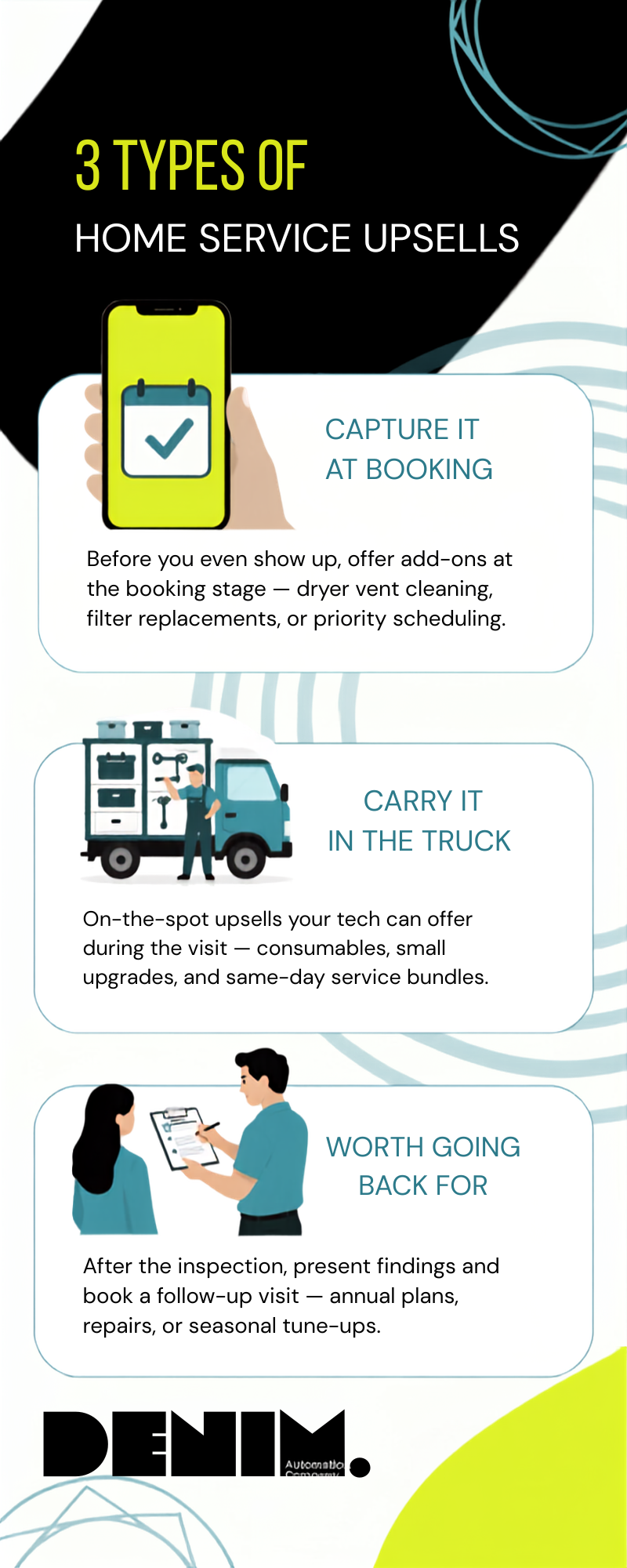
Once I actually thought about it for this post, I realized every upsell we've ever done falls into one of three buckets. Each one solves the "but I have to get to the next job" problem in a different way.
Capture It Before You Even Show Up
The easiest upsell is the one you get before the appointment even starts. When someone books, we always ask if they want any other services while we're there, and we give a discount for booking more than one service in a single appointment. It's the classic "would you like fries with that," except we say it out loud, on purpose, every time. It costs us nothing in extra drive time because we're already going to be at the house. We're just doing more while we're there instead of coming back for a second trip.
Carry It in the Truck
The second bucket is the stuff you can do on the spot, in minutes, because you already brought it with you. Our flex vent is a good example, it's a cheap part that tears up over time from the dryer getting moved in and out. We keep them stocked on the truck, so if a tech sees holes in someone's flex vent, it's a five-second conversation: "Hey, there's holes in your flex vent, want us to swap it out right now?" No estimate, no second appointment, no selling required. We also carry damper locks for gas fireplaces, which in a lot of cases are actually required by code. Three minutes to install, about $40, and it's already in the truck.
The rule for this bucket is simple: if it takes real extra time or a special order, it doesn't belong here. This bucket is only for the stuff you can do while you're already doing the job you came for.
Worth Going Back For
The third bucket is the bigger stuff, the work that's genuinely worth a second trip because it requires more labor, more time, or more skill than you can squeeze into today's appointment. This is where photos matter most. Our techs take pictures at every single house as a standard part of how we work, and a lot of our best upsells come directly from what those photos show. Cracks in the masonry at the top of a chimney let water into the structure. That water gets into the rebar, the rebar expands over time, and the cracking gets worse. What starts as a simple reseal turns into a full rebuild if it sits too long. So when we see it, we show the customer the photo, explain what happens if it's ignored, and offer to get it on the calendar right then. We're not doing that work today, but we're booking it today.
Why We Never Have to Be Pushy About It
I see a lot of home service businesses lean into scare tactics with their upsells, and I think it's the biggest mistake in this whole space. It feels scammy, and customers can tell.
Part of why we can avoid that is pricing. We price our core service so it covers our bills on its own. We're not depending on upsells to make payroll, which means we don't have to be pushy about them, and we definitely don't have to price them like they're the only thing keeping the lights on. The upsells we offer are real things people actually need, backed by a photo, not an inflated add-on dressed up as an emergency. We also give people an out, every time. In Southern California, you genuinely don't need to use your fireplace, it's not freezing out here. So when we find something wrong, we say something like, "Here's the good news: you live in Southern California, you don't have to use your fireplace. If you never plan to use it, you don't need to fix this. If you do want to use it, here's what it'll take." That one sentence changes the entire conversation. Nobody feels cornered. Nobody feels like we invented a problem to make a sale.
"We never have to be pushy, because we're not counting on the upsell to pay the bills."
— Emily Martinez
The Job That Quadrupled Itself
A customer called us for a dryer vent cleaning. When they booked, they mentioned they didn't use their fireplace at all but were curious what condition it was in, so we added on our $55 inspection, nothing formal, just a tech taking a real look.
While he was up there, he found two things. First, the chimney was missing a spark arrestor, which is required by code in Southern California and is exactly the kind of thing insurance companies have started canceling policies over given how much wildfire risk has driven that scrutiny. He had one on the truck, so that was an easy on-the-spot install. Second, he found cracks in the masonry at the top, the same water-into-the-rebar problem from earlier. He took photos, explained what happens if it's left alone, and the customer booked a crown reseal on a separate visit.
That appointment started as a $55 dryer vent inspection. By the time it was done, the ticket had quadrupled, and every part of it came from a part that was already on the truck and a photo that made its own case.
How to Actually Start Doing This in Your Business
If you're starting from zero, you don't need a formal program. You need three small things, added one at a time.
- Add a line to everything: your website, your booking confirmation, your email signature, even your voicemail greeting. Something as simple as "book more than one service in a single appointment and save" plants the idea before you ever show up. If you haven't automated the way you stay in touch with customers at all yet, that system is worth building first, it's the same infrastructure that makes a line like this actually reach people.
- Pick one thing you can carry and install in a few minutes, ideally something tied to code, since that gives the tech an easy, non-salesy reason to bring it up. Stock it on every truck.
- For the bigger stuff, use whatever estimate tool your scheduling software has. We use Housecall Pro. The tech has a real conversation on site, then sends an estimate by text and email within a couple hours, or builds a template for your standard upsells and just attaches it. The customer can approve or decline on their own time, and the system keeps sending a gentle reminder until they respond.
None of this requires your techs to become salespeople, and none of it requires standing around in a driveway they don't have time for. It just requires knowing which bucket the upsell belongs in, capture it at booking, carry it in the truck, or take a photo and go back for it. If you want the rest of the systems that make a business like this run without you in the middle of everything, that's exactly what the 5-system course pack walks through.