When your outreach shows up at the right time, every time, it stops feeling like a sales pitch and starts feeling like a service. My customers don't just tolerate our reminders. They wait for them.
Why timing matters more than the message
In our area, people don't need their chimney swept more than once a year. That means our customers aren't thinking about us very often. And honestly, that's how they like it.
But it creates a real problem. When it's finally time to book again, a lot of people don't remember our company name. If we're counting on them to search online and find us, we might get missed, and someone else gets the job.
So I take outreach seriously. And once you understand your customer's natural rhythm, the question of "when do I reach out?" mostly answers itself. For us, an annual reminder isn't random at all. It lines up with exactly when they need us.
The year we didn't send reminders
Our customers really like us, and one of the things they like most is that they don't have to think about us. We send them something like "It's been a year since our last appointment. Is it time for another one yet?" and they call. That's it. They rely on us to tell them when.
They also wait to hear from us so they can book during our discount season.
Then one year, we were beyond capacity, and we never sent the reminder notices. I figured it wasn't a big deal since we had more work than we could handle anyway.
It was a big deal. A lot of people were irritated with us. The next year, customers contacted us and actually complained that they didn't get their reminder.
"Most business owners are afraid that reaching out will annoy people. My customers were annoyed because we didn't reach out."
— Emily Martinez
Now we send notices every year, no matter how busy we are, just to keep everyone happy.
What most owners get wrong
Most home service businesses haven't built a reminder system yet. Instead, they reach out when they happen to think about it, or when business gets slow and they're nervous.
The problem is that it stays on a mental to-do list. And a mental to-do list is the easiest place in the world to procrastinate. It gets pushed back, then skipped entirely. Whether it actually happens is always up in the air.
Here's where it gets sneaky. Once outreach becomes something you do "sometimes," you start questioning whether it needs to happen at all. You start doubting how valuable your service really is. You start telling yourself you don't want to bother people.
And that's exactly when it does feel random to the customer. A message that shows up only when you're slow, with no pattern behind it, reads like you need the work. A message that shows up on schedule, every year, reads like you're taking care of them.
How I set up our reminders
Everyone's timing will be a little different depending on how often customers need your service. For annual appointments, here's what has worked really well for us:
- 11 months after their last appointment: a reminder email
- 12 months after their last appointment: a postcard reminder
- When our quiet season (our discount season) comes around: a reminder text
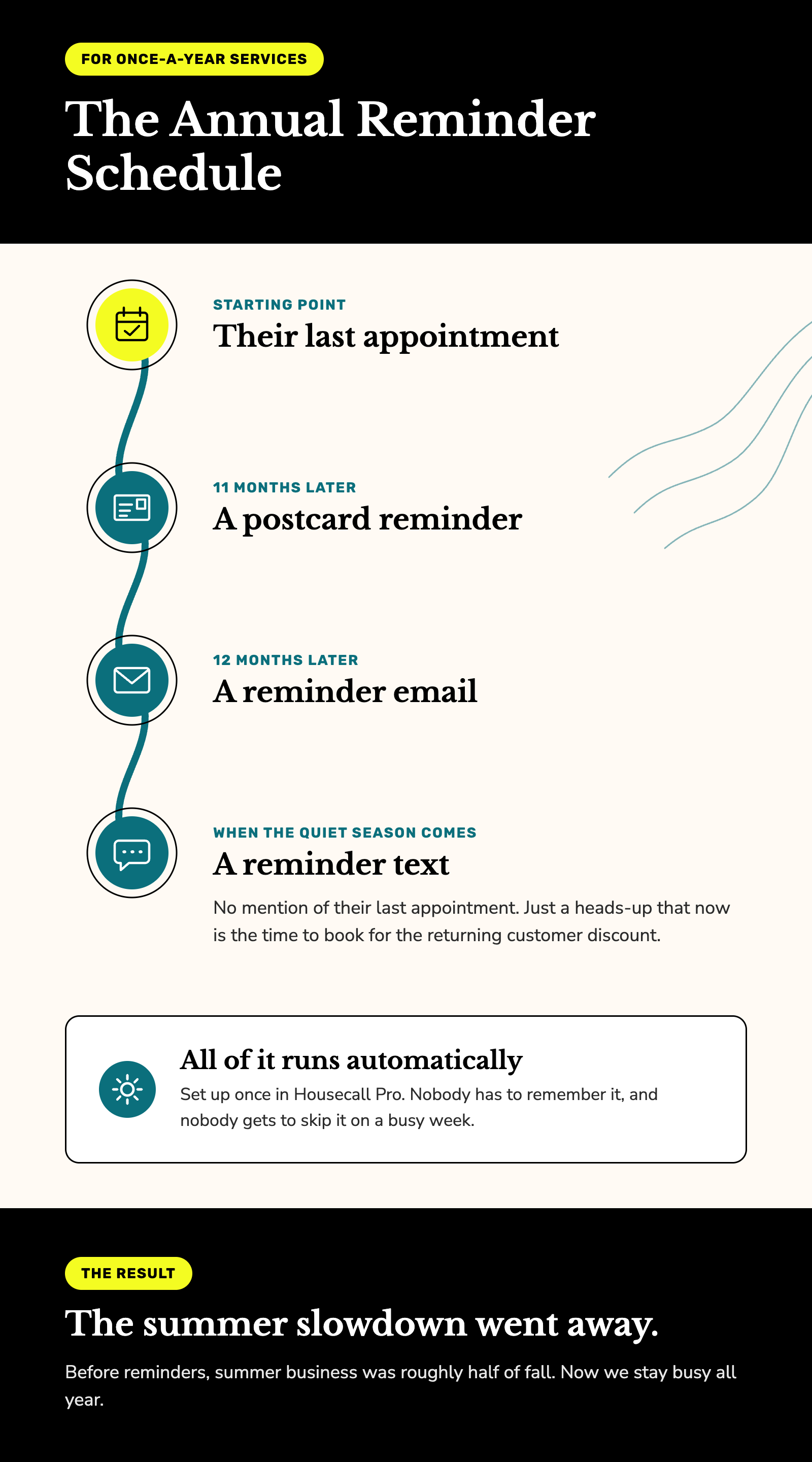
That last text is different from the other two. It doesn't mention their last appointment at all. It just lets them know this is the time of year to book if they want to take advantage of our returning customer discount.
We used to do all of our reminders over the phone, back when people still reliably answered. Now we use the mix of email, postcards, and text, and all of it is automated through Housecall Pro. If you want a closer look at each piece, I broke it down in what my automated stay-in-touch system actually looks like.
Nobody has to remember to do it. Nobody gets to talk themselves out of it on a busy week. It just goes out. That's the whole point. When outreach is a system instead of a decision you have to make every time, it stops being something you doubt. It happens on time, which is exactly what makes it feel expected instead of random.
If you want to see how I set this up step by step, along with the other systems that run my business, it's all in my course on the 5 simple systems I used to automate my local business.
What changed for us
Before we had reminder messages, our summers were quiet. Really quiet. Business was roughly half of what it was in the fall.
Once we added reminders, the dip went away. We stay busy the entire year now.
We've trained our customers to wait for our reminders, and now they reliably book with us when we want them to. That's the part I love most. We're not chasing work during the slow months. We're filling them on purpose, with people who already know and trust us.
The takeaway
Reaching out to old customers doesn't feel random when it's on a schedule that matches when they actually need you.
Figure out your customer's natural rhythm, set up reminders that go out automatically, and stop leaving it to a mental to-do list. Your customers aren't sitting around hoping you'll leave them alone. A lot of them are waiting for you to tell them it's time.